
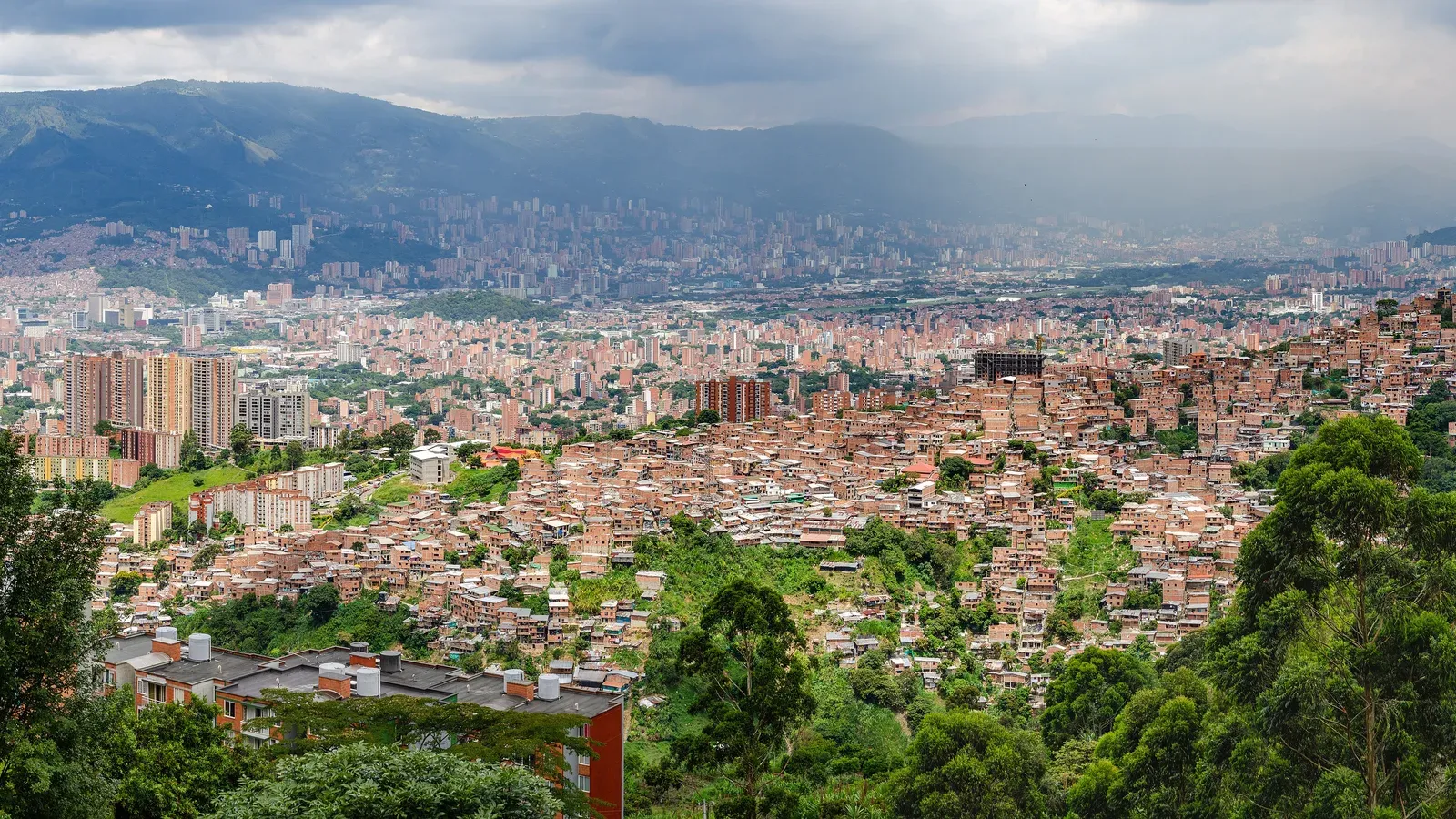
Colombia's taxes at a glance
Structure used: Resident self-employed professional (more than 183 days in 365, on a Visa V for digital nomads) opting into SIMPLE for professional and consulting services: 5.9%, 7.3% or 12% of annual gross income at the 3 profiles, replacing income tax and municipal industry and commerce tax, plus health (12.5%) and pension (16%) contributions on 40% of income. Bands are the effective tax on profit for a remote worker using this structure, with clients abroad and costs of 15% of revenue.
Colombia tax residency: 183 days in any 365
You are a Colombian tax resident if you stay in the country, continuously or not, for more than 183 calendar days in any period of 365 consecutive days, counting the days you arrive and leave (Tax Statute, article 10). Colombian nationals face extra tests tied to family, income and assets; for a foreigner the day count is the only test.
The window rolls, so the calendar year does not reset it. A stay from October to April passes 183 days without passing them in either calendar year, and article 10 handles that case by making you resident from the second year: arrive on October 1, 2026, stay to the end of April, and 2027 is your first resident year.
Your visa does not settle it either. The Visa V for digital nomads lets you live and work remotely in Colombia for up to 2 years, and tax residence still comes only from the days you spend there.
Your first year in Colombia: the version that holds up
Works
You arrive in January on a Visa V, expect to pass 183 days, register for a tax ID (RUT) as a new taxpayer and choose SIMPLE at registration, then issue electronic invoices and pay 5.9% to 14.5% of gross income instead of the ordinary rates.
Fails
You spend 150 days in Medellín, work for US clients from a coworking space and file nothing because you are not resident. Fees for work done in Colombia are Colombian-source under article 24, so as a non-resident you owe a flat 35% on them, and SIMPLE is closed to non-residents.
Colombia income tax rates for 2026
Residents pay progressive rates on the general income basket after costs and exemptions. The scale in article 241 is set in UVT, a tax unit worth COP 52,374 (about $16) in 2026 under DIAN Resolution 000238, and runs from 0% on the first 1,090 UVT to 39% above 31,000 UVT.
Colombia income tax for resident individuals, 2026 (general income basket)
| Taxable income (UVT) | Taxable income (COP) | About (USD) | Tax |
|---|---|---|---|
| Up to 1,090 | Up to 57,087,660 | Up to $17,300 | 0% |
| 1,090 to 1,700 | 57,087,660 to 89,035,800 | $17,300 to $26,900 | 19% of the excess over 1,090 UVT |
| 1,700 to 4,100 | 89,035,800 to 214,733,400 | $26,900 to $64,900 | 116 UVT plus 28% of the excess over 1,700 UVT |
| 4,100 to 8,670 | 214,733,400 to 454,082,580 | $64,900 to $137,300 | 788 UVT plus 33% of the excess over 4,100 UVT |
| 8,670 to 18,970 | 454,082,580 to 993,534,780 | $137,300 to $300,400 | 2,296 UVT plus 35% of the excess over 8,670 UVT |
| 18,970 to 31,000 | 993,534,780 to 1,623,594,000 | $300,400 to $491,000 | 5,901 UVT plus 37% of the excess over 18,970 UVT |
| Over 31,000 | Over 1,623,594,000 | Over $491,000 | 10,352 UVT plus 39% of the excess over 31,000 UVT |
SIMPLE: one rate on gross income
SIMPLE replaces income tax and the municipal industry and commerce tax with one rate on gross income. Individuals running a business, including professional and consulting work, can opt in if they are resident in Colombia, national or foreign, had gross income under 100,000 UVT (about $1.58 million) the year before, and are registered in the RUT with electronic invoicing and signature (Tax Statute, article 905).
SIMPLE rates for professional, consulting and scientific services (article 908)
| Annual gross income (UVT) | Annual gross income (COP) | About (USD) | Rate |
|---|---|---|---|
| Under 6,000 | Under 314,244,000 | Under $95,000 | 5.9% |
| 6,000 to 15,000 | 314,244,000 to 785,610,000 | $95,000 to $237,600 | 7.3% |
| 15,000 to 30,000 | 785,610,000 to 1,571,220,000 | $237,600 to $475,100 | 12% |
| 30,000 to 100,000 | 1,571,220,000 to 5,237,400,000 | $475,100 to $1,583,800 | 14.5% |
Under article 908 the rate for your band applies to all of the year's gross income, and costs are not deducted. SIMPLE is for freelancers and contractors, not employees: article 906 excludes residents whose work is in substance an employment relationship, and anyone whose passive income is 20% or more of gross income. Timing matters too: a taxpayer already in the RUT has to switch to SIMPLE by the last business day of February of the year it applies to, while someone registering in the RUT for the first time can choose it at registration (article 909).
Social security comes on top on either route. A resident independent worker must join the health and pension systems (Law 100 of 1993, articles 15 and 157, and Law 1438 of 2011, article 32), and the UGPP guide for independent workers sets health at 12.5% and pension at 16% of a base of 40% of income, about 11.4% of revenue, or 11.8% once the 1% solidarity surcharge applies. Visa V holders are not excluded, and the private health policy the visa requires does not replace the system; a foreigner who pays into a pension at home owes the health part only.
| Revenue6,314 UVT, in the 7.3% SIMPLE band | COP 330,686,000 ($100,000) |
|---|---|
| SIMPLE at 7.3% of gross income8.59% of a profit of $85,000 | COP 24,140,078 (about $7,300) |
| Health 12.5%, pension 16% and solidarity 1% on 40% of revenueowed on either route | COP 39,020,948 (about $11,800) |
| SIMPLE plus contributions22.47% of profit, the Index figure | COP 63,161,026 (about $19,100) |
| Ordinary regime: profit after 15% costs5,367 UVT | COP 281,083,100 ($85,000) |
| Less health and pension contributions, non-taxable income (articles 55 and 56) | COP 39,020,948 |
| Taxable income4,622 UVT | COP 242,062,152 |
| 788 UVT plus 33% of the excess over 4,100 UVT | 960 UVT |
| Ordinary income tax17.9% of profit | COP 50,289,200 (about $15,200) |
| Ordinary income tax plus contributions31.8% of profit | COP 89,310,148 (about $27,000) |
Exchange rate COP 3,306.86 per $1, the Banco de la República TRM valid September 26 to 28, 2026; UVT COP 52,374 (about $16). SIMPLE rates from article 908, ordinary rates from article 241, contribution rates from the UGPP guide for independent workers. Mandatory health and pension contributions are non-taxable income under articles 55 and 56 and come off before costs under article 336.
Foreign income and remote work in Colombia
Residents, nationals and foreigners alike, are taxed on income and gains from Colombian and foreign sources from their first resident year, with no relief for newcomers (Tax Statute, article 9). Foreign interest, rents and gains all go on the Colombian return.
Before residence, the work itself is already Colombian. Fees, salaries and commissions are Colombian-source when the work is done in Colombia, wherever the client is or the payment is made (article 24), and a non-resident pays a flat 35% on Colombian-source taxable income (article 247). That is why SIMPLE, not the day count, is the lever: it is one of the reasons Colombia sits among the low-tax countries for remote workers, and it is open only to residents.

David's note
If I expected to stay in Colombia past 183 days, I would plan to be resident rather than try to avoid it. A non-resident pays 35% on every peso earned from work done there, while a resident freelancer in SIMPLE pays 5.9% or 7.3% of gross income at typical freelance revenue, so the short stay is often the expensive one.
Filing a tax return in Colombia
Individuals file the income tax return in the second half of the year, on a date set by the last 2 digits of their tax ID: for 2025 income the window ran from August 12 to October 26, 2026 (DIAN 2026 tax calendar). SIMPLE taxpayers file one consolidated annual return with payment in April, April 20 to 24 in 2026, and pay bimonthly advances through the year, although individuals with income under 3,500 UVT (about $55,400) file only the annual return (article 910).
Registering and filing as a freelancer in Colombia
- Count days on a rolling basis: more than 183 in any 365, including arrival and departure days, makes you resident.
- Register in the RUT, and if you are new to it, choose SIMPLE at registration; otherwise switch by the last business day of February.
- Set up electronic invoicing within 2 months of joining SIMPLE, and invoice every client, foreign ones included.
- Pay SIMPLE bimonthly advances on the DIAN calendar once your income passes 3,500 UVT.
- File the SIMPLE annual return with payment in April, or the ordinary return between August and October, on the date for your tax ID.
- File the annual return of assets held abroad on the same dates as the income tax return.
- If you own 10% or more of a foreign company, work out whether it is a controlled foreign entity before the return is due.
Ways to move to Colombia
Special tax regimes in Colombia
SIMPLE unified tax regime (Regimen Simple de Tributacion)
Resident individuals running a business, including professional and consulting services, can opt into SIMPLE, which replaces income tax and municipal industry and commerce tax with one rate on gross income. For professional services the rate is 5.9% to 14.5%, set by annual gross income. Revenue must stay under 100,000 UVT, about COP 5,237 million (about $1.58 million).
Open to new applicants. Source: secretariasenado.gov.co, checked September 29, 2026. The rate for the bracket is applied to all gross income of the year, not only to the part inside the bracket (reading of article 908; no DIAN ruling read)
Running your own company from Colombia
Colombia's controlled foreign entity rules, the ECE regime, reach founders directly. A foreign company, trust, fund or foundation is an ECE when Colombian residents control it, and every resident holding 10% or more must include its passive income, such as dividends, interest and royalties, in their own income (Tax Statute, articles 882 to 884). Control is presumed for entities in non-cooperative or low-tax jurisdictions whatever your stake, and the rule applies whether or not the entity is transparent for tax purposes.
Active trading income of a foreign company is generally not attributed under the ECE rules; it reaches you when the company pays it out, and as a resident that dividend is part of your worldwide income. What a company does not change is where the work happens: pay for work you do while in Colombia is Colombian-source under article 24, whoever pays it.
SIMPLE is available to companies too, but only to Colombian companies whose partners or shareholders are all individuals resident in Colombia (article 905). Foreign companies, their branches and the subsidiaries of foreign owners are excluded by article 906, so a foreign company you own cannot use it.
How each structure is taxed for a resident of Colombia
| Structure | Work for foreign clients done in Colombia | Foreign passive income | Profit paid out to you |
|---|---|---|---|
| You, in SIMPLE | 5.9% to 14.5% of gross income | Taxed as worldwide income | Nothing further |
| You, ordinary regime | 0% to 39% on profit | Taxed as worldwide income | Nothing further |
| Foreign company you control | Your pay for work done in Colombia is Colombian-source | Attributed to you under the ECE rules | Part of your worldwide income |
US citizens living in Colombia
The US has no income tax treaty with Colombia, so a US citizen resident there is taxed by both countries and files a US return on worldwide income. The foreign earned income exclusion covers up to $132,900 of earned income for 2026 (IRS, IR-2025-103), and a foreign tax credit for Colombian tax paid is the alternative when Colombia's bill is the larger one.
There is no totalization agreement either, so self-employment tax of 15.3% applies to all net profit even when the exclusion is claimed, whatever you pay into the Colombian systems.
Colombia tax mistakes: the short stay and the missed SIMPLE deadline
Staying under 183 days does not make your work untaxed
The expensive version is a nomad who spends 5 months a year in Medellín on remote work, stays under 183 days to avoid residence, and files nothing. Work done in Colombia is Colombian-source, so as a non-resident the fees are taxable at a flat 35%, far above the 5.9% to 7.3% that SIMPLE would have charged a resident on typical freelance revenue.
The second mistake is timing SIMPLE. An existing RUT registrant who misses the last business day of February is in the ordinary regime for that whole year, and once chosen, SIMPLE has to be kept for the year.
The third is the rolling count. Because the 183 days run across any 365, 2 long winters in Colombia can make you resident even when neither calendar year looks long on its own.
Who Colombia suits, and who it does not
Good fit
- Freelancers and consultants with foreign clients who will live in Colombia for more than 183 days a year and can opt into SIMPLE at 5.9% to 14.5% of gross income.
- Remote workers with at least COP 5,252,715 (about $1,590) a month, the lowest digital nomad visa floor in this group.
Poor fit
- Anyone with large foreign investment income or holding companies: residents are taxed on worldwide income at up to 39%, and passive income of controlled foreign entities is attributed.
- People with a net worth of 72,000 UVT or more on January 1 (about COP 3,771 million, about $1.14 million), who owe the annual wealth tax at 0.5% to 1.5%.
- Short stays under 183 days: the work is still Colombian-source, and SIMPLE is closed to non-residents.
Recent tax and visa changes in Colombia
Constitutional Court ruling C-079 of 2026 struck down Emergency Decree 1474 of 2025 in full, including its lower 40,000 UVT wealth tax threshold for individuals; DIAN may not assess or collect taxes under it, and the Law 2277 threshold of 72,000 UVT applies. corteconstitucional.gov.co
Decree 159 of 2026 set the 2026 minimum wage transitionally at COP 1,750,905 after the Council of State suspended Decree 1469 of 2025 on February 12, 2026; it stays in force until the Council rules on the annulment case. Visa income floors are set in minimum wages. dapre.presidencia.gov.co
DIAN Resolution 000238 set the 2026 UVT at COP 52,374. dian.gov.co

