
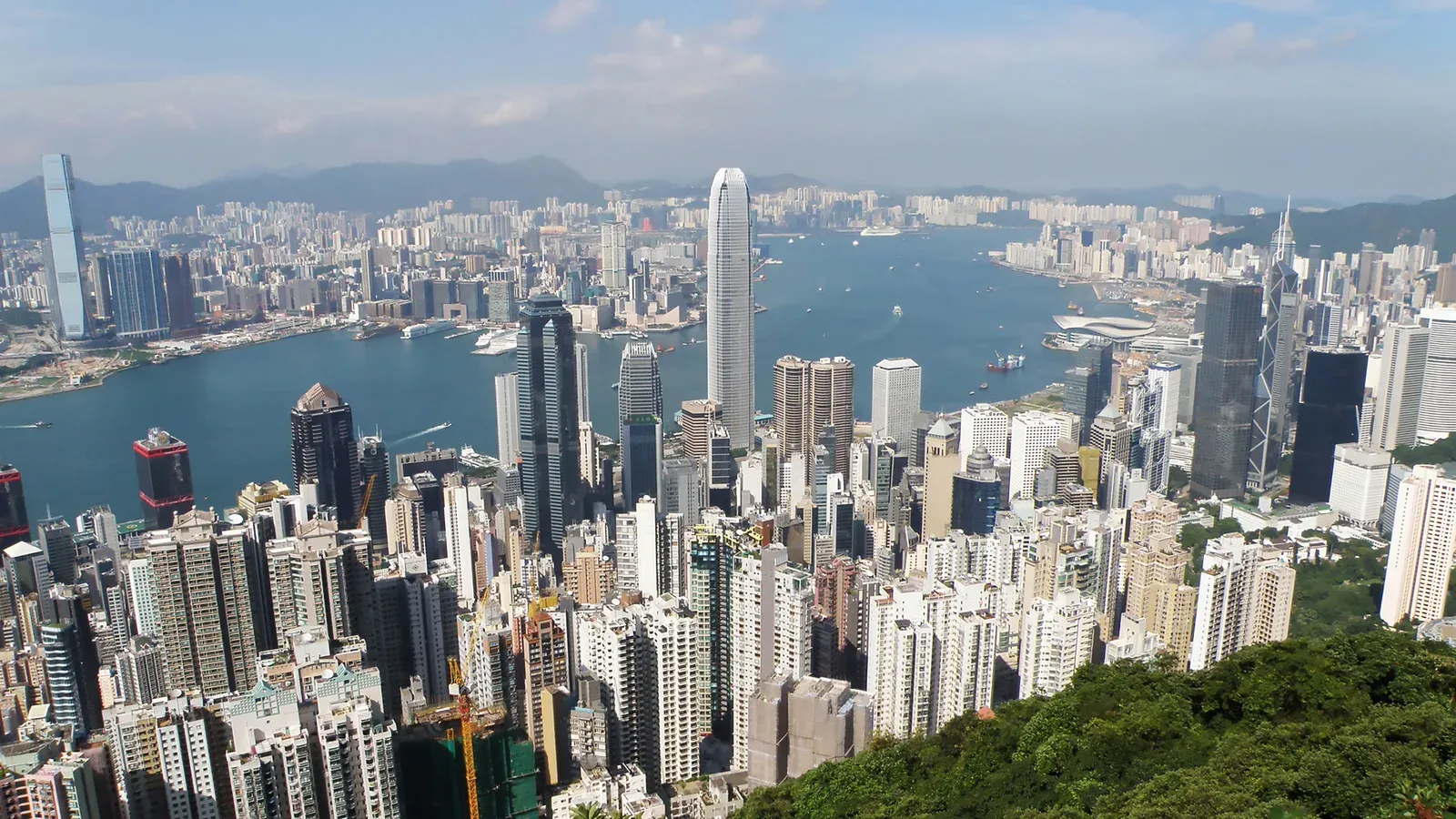
Hong Kong's taxes at a glance
Structure used: Sole trader on a Top Talent Pass, taxed on profits from services performed in Hong Kong at the lower of two-tiered profits tax (7.5% up to HKD 2,000,000) and personal assessment, plus mandatory MPF of 5% capped at HKD 18,000 a year. Bands are the effective tax on profit for a remote worker using this structure, with clients abroad and costs of 15% of revenue.
Hong Kong tax residency: why the day count barely matters
Hong Kong does not tax people by residence. Under the Inland Revenue Department's profits tax rules, anyone carrying on a trade, profession or business in Hong Kong is taxed on profits arising in or derived from Hong Kong, with no distinction between residents and non-residents, and no tax is charged on profits arising abroad, even if they are remitted to Hong Kong. Salaries tax on employment income works on the same idea.
The tax year, called the year of assessment, runs from April 1 to March 31. Days in Hong Kong matter in only 2 places:
- A certificate of resident status: to claim a tax treaty benefit, the IRD certifies you as resident if you ordinarily reside in Hong Kong, stay more than 180 days in a year of assessment, or stay more than 300 days over 2 consecutive years that include it, per its certificate of residence FAQ.
- Visits by employees of a foreign employer: if your job is based and supervised outside Hong Kong, pay for services rendered on visits totaling 60 days or fewer in the year of assessment is exempt from salaries tax, counting both the arrival and the departure day, per the IRD guide for people coming to work in Hong Kong.
A freelancer gets no day allowance like that. Profits tax has no minimum stay, so a sole trader who carries on business from Hong Kong is taxed on the profit from work performed there, however few days it took.
Hong Kong tax rates for a sole trader: profits tax or personal assessment
A freelancer in Hong Kong is a sole proprietor and pays whichever of 2 calculations comes out lower. Under the two-tiered profits tax rates, unincorporated businesses pay 7.5% on the first HKD 2,000,000 (about $255,000) of assessable profit and 15% above. Personal assessment, which you elect on your return, instead runs the salaries tax scale over your income after the basic allowance of HKD 145,000 (about $18,500) from 2026/27 and MPF contributions of up to HKD 18,000 (about $2,290), per the IRD's allowance and rate table.
Hong Kong salaries tax and personal assessment scale, 2024/25 onward
| Net chargeable income | Rate | Total tax at the top of the band |
|---|---|---|
| First HKD 50,000 (about $6,370) | 2% | HKD 1,000 |
| Next HKD 50,000, to HKD 100,000 (about $12,700) | 6% | HKD 4,000 |
| Next HKD 50,000, to HKD 150,000 (about $19,100) | 10% | HKD 9,000 |
| Next HKD 50,000, to HKD 200,000 (about $25,500) | 14% | HKD 16,000 |
| Remainder | 17% | HKD 16,000 plus 17% of the excess |
| Cap: standard rate on net income before allowances | 15% on the first HKD 5,000,000, 16% above | Applies when lower than the scale |
Tax on a single sole trader's profit in Hong Kong with no other income, 2026/27 allowances, MPF deducted under personal assessment
| Profit for the year | Profits tax | Personal assessment | You pay |
|---|---|---|---|
| HKD 300,000 (about $38,200) | HKD 22,500 | HKD 8,000 | HKD 8,000 (about $1,020) |
| HKD 500,000 (about $63,700) | HKD 37,500 | HKD 39,290 | HKD 37,500 (about $4,780) |
| HKD 1,000,000 (about $127,000) | HKD 75,000 | HKD 124,290 | HKD 75,000 (about $9,560) |
| HKD 2,000,000 (about $255,000) | HKD 150,000 | HKD 294,290 | HKD 150,000 (about $19,100) |
The crossover sits a little under HKD 500,000 (about $63,700) of profit: below it personal assessment wins, above it the flat 7.5% does. On top of either comes MPF, the 5% retirement contribution a self-employed person pays into their own account on relevant income from HKD 85,200 (about $10,900) a year, capped at HKD 18,000 (about $2,290), under the MPF Schemes Authority's rules.
Remote work from Hong Kong: taxed where you perform it
For service fees, the IRD's practice note on the source of profits looks at the place where the services that earn the fees are performed. A designer living in Hong Kong who works for clients in London and Sydney performs the services in Hong Kong, so the profit is Hong Kong-sourced even though no client, contract or payment touches the city. When the work is done partly in Hong Kong and partly abroad, the IRD accepts apportioning the fees between the 2.
Income that really does arise abroad is left alone, and individuals pay no tax on dividends or capital gains, according to PwC's Hong Kong summary. That makes Hong Kong one of the plainest cases among the territorial tax countries: the line is drawn by where income arises, and nothing about your residence moves it.
A freelancer living in Hong Kong with only foreign clients
Works
You register as a sole proprietor, file every year and pay 7.5% on the profit from work done in Hong Kong. Fees for work you performed on documented trips abroad are apportioned out as offshore, and your dividends and investment gains stay untaxed.
Fails
You work from your apartment in Sheung Wan for clients in Europe and file nothing, sure that foreign clients paying into a foreign account make the income offshore. The services were performed in Hong Kong, so HKD 1,000,000 (about $127,000) of profit owes HKD 75,000 (about $9,560) in profits tax for each year, before penalties.
Filing a Hong Kong tax return
Hong Kong tax checklist for a sole trader
- Register your sole proprietorship with the IRD's Business Registration Office, and renew the certificate each year when the demand note arrives.
- Enroll in an MPF scheme and pay 5% of relevant income at the interval you choose when enrolling.
- Keep invoices and a travel log showing where each piece of work was performed, because that decides which fees are Hong Kong profit.
- File the individual tax return (BIR60), which the IRD issues in early May, within 3 months if you owned a sole proprietorship in the year, or 1 month otherwise, plus 1 month when you file electronically, per the IRD's filing rules.
- Elect personal assessment on the return when your profit is low enough for the scale to beat the 7.5% rate.
Ways to move to Hong Kong
Special tax regimes in Hong Kong
Two-tiered profits tax for unincorporated businesses
Sole proprietors and partnerships pay 7.5% on the first HKD 2,000,000 (about $255,000) of assessable profits and 15% on the rest. It applies automatically; connected entities share one lower tier.
Open to new applicants. Source: gov.hk, checked September 29, 2026
Running your own company while living in Hong Kong
Hong Kong has no controlled foreign company rules for individuals and does not tax dividends, so a foreign company you own can pay you dividends in Hong Kong without Hong Kong tax. The catch is the same as for your own freelancing: profits from operations carried out in Hong Kong can be taxed, and a foreign company run from Hong Kong may owe profits tax on them.
A Hong Kong limited company pays profits tax of 8.25% on the first HKD 2,000,000 (about $255,000) of assessable profit and 16.5% above, again only on Hong Kong-source profit. For a founder who lives in Hong Kong and does the work there, that makes the company dearer than a sole proprietorship at every level of profit, and it has to file audited accounts every year. Its offshore claim, which leaves fees for work performed outside Hong Kong untaxed, only helps when the work really is performed outside Hong Kong.
Sole proprietorship or Hong Kong company, for a founder who lives and works in Hong Kong
| Point | Sole proprietorship | Hong Kong limited company |
|---|---|---|
| Tax on the first HKD 2,000,000 of profit | 7.5% | 8.25% |
| Tax on profit above HKD 2,000,000 | 15% | 16.5% |
| Personal assessment scale as an option | Yes, when lower | No |
| Tax on profit paid out to you | None, the profit is already yours | None on dividends |
| Fees for work performed in Hong Kong | Taxed | Taxed |
| Fees for work performed outside Hong Kong | Apportioned out as offshore | Offshore claim, proved in the tax return |

David's note
If you live in Hong Kong and do the work there, I would start as a sole proprietor. The company costs more in tax and in yearly audit fees, and its offshore claim does nothing for work you do from your own desk in the city.
US citizens living in Hong Kong
Hong Kong is not on the IRS list of income tax treaty countries and not among the 31 countries with a US totalization agreement, so MPF does not replace US Social Security. An American freelancing from Hong Kong reports worldwide income to the IRS and can exclude up to $132,900 of 2026 earnings under the foreign earned income exclusion, or credit the Hong Kong tax paid instead. Self-employed Americans still owe 15.3% on 92.35% of net profit, about $14,130 on $100,000 of net profit, which the exclusion does not reduce.
The costliest Hong Kong mistake: calling your own work offshore
Foreign clients do not make work done in Hong Kong offshore
The offshore rule covers profit from services performed outside Hong Kong, not profit paid from outside. A freelancer who lives in Hong Kong, nets HKD 1,500,000 (about $191,000) a year from foreign clients and files nothing owes HKD 112,500 (about $14,300) of profits tax for every year missed, and the IRD's heavy penalties for failing to notify, failing to file or filing an incorrect return come on top.
Waiting for a tax return does not protect you either. The IRD expects anyone who is liable to tax but has not been sent a return to notify it within 4 months after the end of the basis period, so a freelancer who arrives mid-year and hears nothing still has to come forward.
Leaving your old country's tax net is a separate job. Hong Kong's rules do not change what your previous country thinks of you, and if it still claims you as resident, a treaty claim needs the IRD's certificate of resident status, which in turn needs more than 180 days in the year of assessment, 300 days over 2 years, or ordinary residence.
Who Hong Kong suits, and who it does not
Good fit
- High earners with HKD 2,500,000 (about $319,000) or more a year, or graduates of eligible universities, who qualify for the Top Talent Pass.
- Investors living on dividends and capital gains, which Hong Kong does not tax.
- Sole traders with up to HKD 2,000,000 (about $255,000) of profit, taxed at 7.5%.
Poor fit
- Freelancers without a qualifying degree or income: there is no nomad visa.
- Anyone expecting work done in Hong Kong for foreign clients to be tax free.
Recent tax and visa changes in Hong Kong
Basic allowance raised from HKD 132,000 to HKD 145,000 from 2026/27. ird.gov.hk
Two-tiered standard rate for salaries tax and personal assessment from 2024/25: 15% on the first HKD 5,000,000 of net income, 16% above. ird.gov.hk
New Capital Investment Entrant Scheme opens: HKD 30,000,000 of permissible investments. newcies.gov.hk

.jpg)